
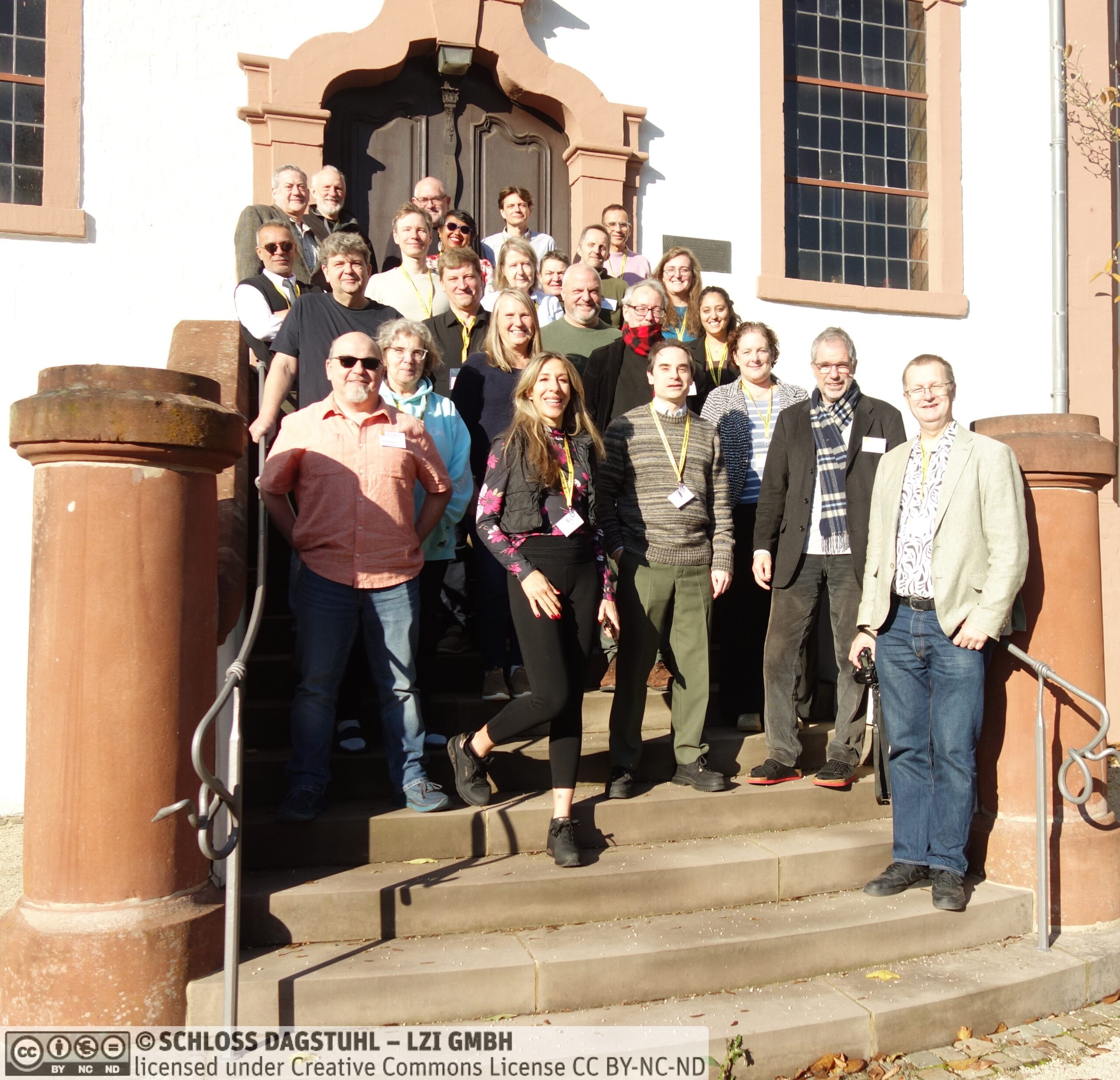
 Developments on the Cross-Domain Interoperability Framework (CDIF) have been moving rapidly since the release of version 1.1 and the launch of the CDIF4EOSC project in June 2026. Work has been focused on both immediate- and longer-term objectives, in a variety of areas. Chief among these are the new profiles under development, a long-running process which is now bearing fruit. Efforts to support the further development of cross-domain metadata models at W3C are on-going, and there are developments in terms of tools, maintenance, and training. The recent workshop ‘Optimising Metadata Structures for Alignments with Standard Models at the Point of Use’ at the Leibniz Foundation’s Schloss Dagstuhl in Wadern, Germany saw many of these activities come to a head.
 New Profiles: Provenance, Access Rights and DCAT-Syntax for Core and Discovery Profiles
Among the work at Dagstuhl on new CDIF profiles was the finalisation of a PROV-based profile for provenance information. This work has benefitted from activities within the Climate-Adapt4EOSC project and the now-completed CDIF-4-XAS project. Accompanying this was work on the revised Access Rights profile, the revision of which was ably assisted by Beatriz Esteves, an active member of the W3C working groups which develop the Open Digital Rights Language (ODRL) and the Data Privacy Vocabulary (DPV), standards on which the Access profiles relies. Further work on profiles includes the addition of Core and Discovery profiles using DCAT as an alternative to Schema.org (both versions will be supported). The release of these new profiles is scheduled for the first quarter of 2026!
 Collaboration with DRUM (units of measure) and W3C
Longer-term work includes interactions with some external bodies. The recommendations around Units of Measure are now being revisited in collaboration with CODATA’s Digital Representation of Units of Measure (DRUM) Task Group at CODATA, involving experts from the International System of Units (SI) and Quantities, Units, Dimensions, and Types (QUDT) groups and others. Members of the CDIF community have also been heavily engaged in collaborations with the re-chartered W3C Dataset Exchange Working Group, which is now developing a Variable Description Vocabulary (VVD) based on the DDI variable Cascade model used in CDIF and elsewhere. This latter effort included the attendance of several representatives of that group at the Dagstuhl workshop.
Model-driven production platform
The creation of a model-driven production platform for CDIF is also moving forward, with a first production version expected to be completed by the end of the year, and used with some of the new profiles. This work has included the creation of a formal model of all of the specifications on which CDIF relies in its recommendations, as a means to align metadata across specifications. While this resource is only being developed for the first time, it offers exciting possibilities for better understanding cross-standard alignments, and providing a strong foundation for consistency across the growing body of CDIF profiles.
Tools support for CDIF Implementation
Tools support for the implementation of the CDIF recommendations has been further expanded by the release of a set of format converters, going from a dozen common domain and application formats to and from the corresponding CDIF profiles. Supported formats include Croissant ML, DDI Codebook, DDI-CDI, RO Crate, FAIR2, Science on Schema.org (SOSO) and others. This set of tools will continue to expand. Work has also started in the creation of a variables registry, comprising all the variables found in the repositories of the Dataverse Community network, exposed with CDIF metadata. This registry is aimed at providing a rich resource for responsible use by agentic AI, and will continue to be developed.
AI continues to play a major role in regards to CDIF in other ways, too, helping to connect it with the rich set of information about scientific data. In projects like the recently launched AI4Social+ project, funded by the European commission, and within the official statistics community at the UN, we are seeing CDIF both supporting AI readiness and serving as a powerful tool for the creation of metadata by data producers.
CDIF4EOSC Roadmaps, February 2027
The CDIF4EOAC project will be the biggest driver of CDIF development in the near term. In February, the detailed roadmap for CDF development through the project will be released, with the promised development of a profile for data quality, the description of software as a FAIR resource, a FAIR mappings profile, and more. Accompanying this will be a plan for the release of software tools to support many of the CDIF profiles, including the creation of ODRL Access Policies, easy creation of CDIF metadata and more. The CDIF4EOSC Use Cases — oceanographic data, safe and sustainable development of advanced materials, and combined use of climate and social science data — will also release their requirements and gap analyses, showing how CDIF can benefit users in these diverse scenarios. Finally, a plan for the technical integration of CDIF (adoption of profiles, use of tools and services) in the EOSC ecosystem (nodes, federation and linked Common European Data Spaces) will also be released. Likewise, the development of training materials for CDIF is also planned. A first CDIF4EOSC training activity was undertaken at the CODATA-RDA Schools of Research Data Science in Trieste in November. CDIF resources from the project will all be brought together in a CDIF “Playbook” intended as a detailed implementer’s manual to support organisational adoption in EOSC and beyond.
There are lots of new developments around CDIF, and the pace promises to increase in coming months, particularly with the release of the CDIF Roadmaps in February 2027.
CDIF Book: https://cdif.codata.org
CDIF4EOSC Project: https://cdif4eosc.eu
CDIF Stakeholder Forum: coming soon
CDIF International Community List: https://bit.ly/Joint-CDIF-Community
Feedback: cdif-feedback@codata.org