Crises rarely wait for institutions to be ready for them. Floods, epidemics, earthquakes and displacement events unfold across borders, sectors and time zones, and the organisations that respond to them succeed or fail depending on whether they can find, trust and share the right data fast enough. That simple observation sits at the heart of the Data Policies for Times of Crisis (DPTC) Toolkit, developed jointly by UNESCO and the International Science Council’s Committee on Data (CODATA), and it was the common theme of two sessions to which CODATA contributed at the 2026 Global Conference of the International Decade of Sciences for Sustainable Development (IDSSD) in Paris: the ISC session on 16 July ‘Resilient Science for Resilient Societies: Protecting Knowledge and Scientists in Times of Crisis’, and the dedicated UNESCO–CODATA thematic session on 17 July ‘Data policies for times of crisis: Enabling open science for coordinated response’.
Two sessions, one message
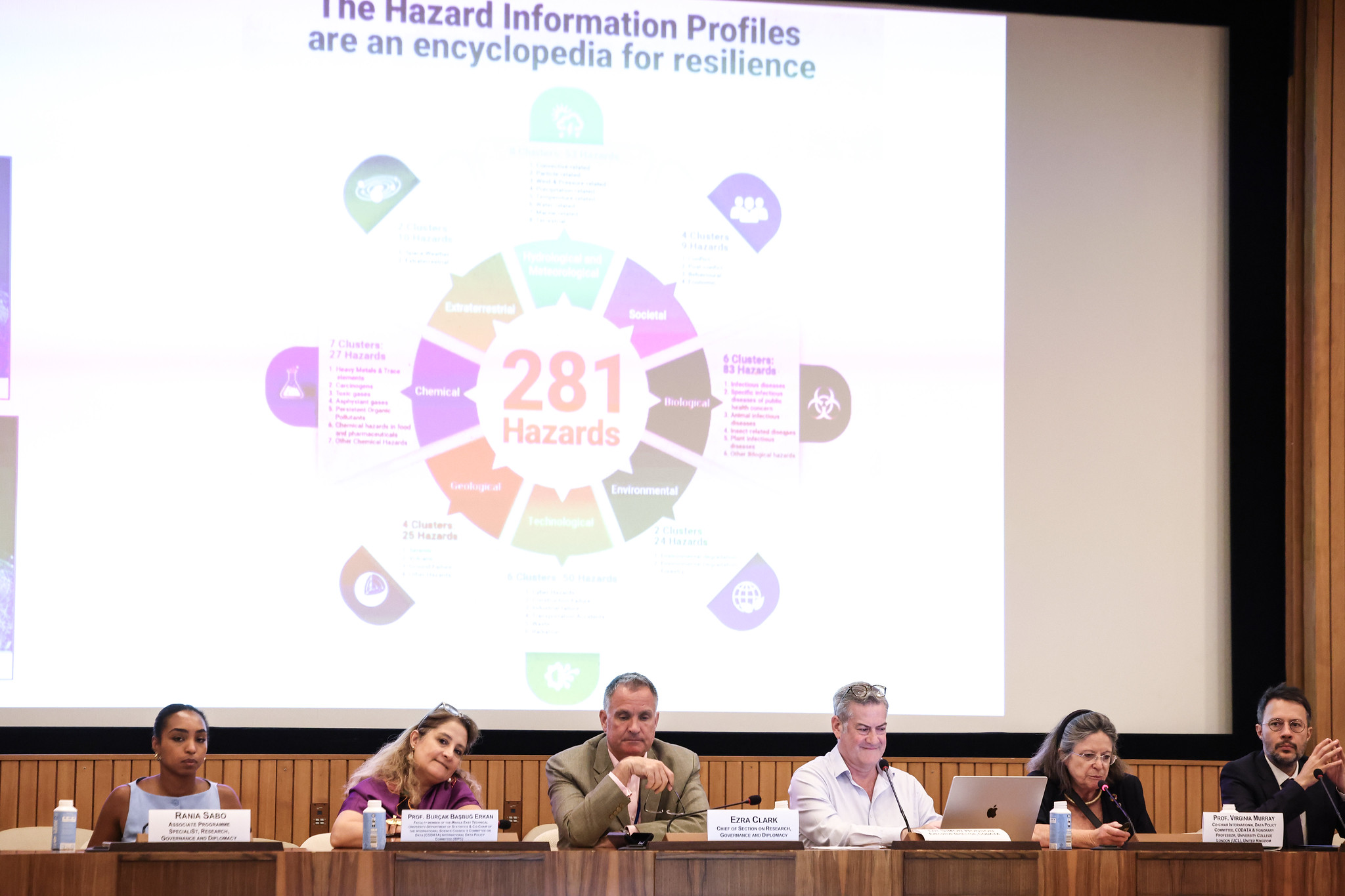 CODATA’s DPTC work was presented first at the ISC session on 16 July. In the first panel, Prof Virginia Murray, as chair of the UNDRR-ISC HIP Steering Committee, shared the UNDRR-ISC Hazard Information Profiles update 2025 (HIPs). In the second panel, Prof Burçak Başbuğ gave examples from the recovery process after the 2023 Kahramanmaras earthquakes.
On 17 July, the thematic session at UNESCO Headquarters brought the need for data in times of crises (DPTC) message to a dedicated 75-minute hybrid slot in Room XI, opened by Dr Ezra Clark (Chief of Section, Research, Governance and Diplomacy, UNESCO) and closed by Dr Simon Hodson (Executive Director, CODATA). Together, the two sessions made the case that open science is not an abstract ideal for times of crisis — it is operational infrastructure, and the DPTC Toolkit is one attempt to help build it.
The DPTC Toolkit itself — a factsheet, a guidance document and a checklist — was published as part of the UNESCO Open Science Toolkit in June 2025. It is grounded in the 2021 UNESCO Recommendation on Open Science and aligned with the FAIR (Findable, Accessible, Interoperable, Reusable), CARE (Collective benefit, Authority to control, Responsibility, Ethics) and TRUST (Transparency, Responsibility, User focus, Sustainability, Technology) principles — three frameworks that, taken together, ask not only whether data can be shared, but whether it should be, and on whose terms.
Putting the Toolkit to the test: the first global survey
The centrepiece of the 17 July session was the presentation of findings from the first global UNESCO-CODATA survey on the implementation of data policies for times of crisis, conducted between March and June 2026 and presented by Ms Rania Sabo (UNESCO) and Prof Burçak Başbuğ Erkan (METU Department of Statistics; Co-Chair, CODATA International Data Policy Committee).
To read more, go to the CODATA blog