
This blog post was inspired by the opportunity to join the Urban Risk and Climate Risk Data Lab event hosted by the World Bank Group in Paris, 21st to 22nd May 2026.
By Burçak Başbuğ, Shaily Gandhi, Matti Heikkurinen, and Slava Tykhonov.
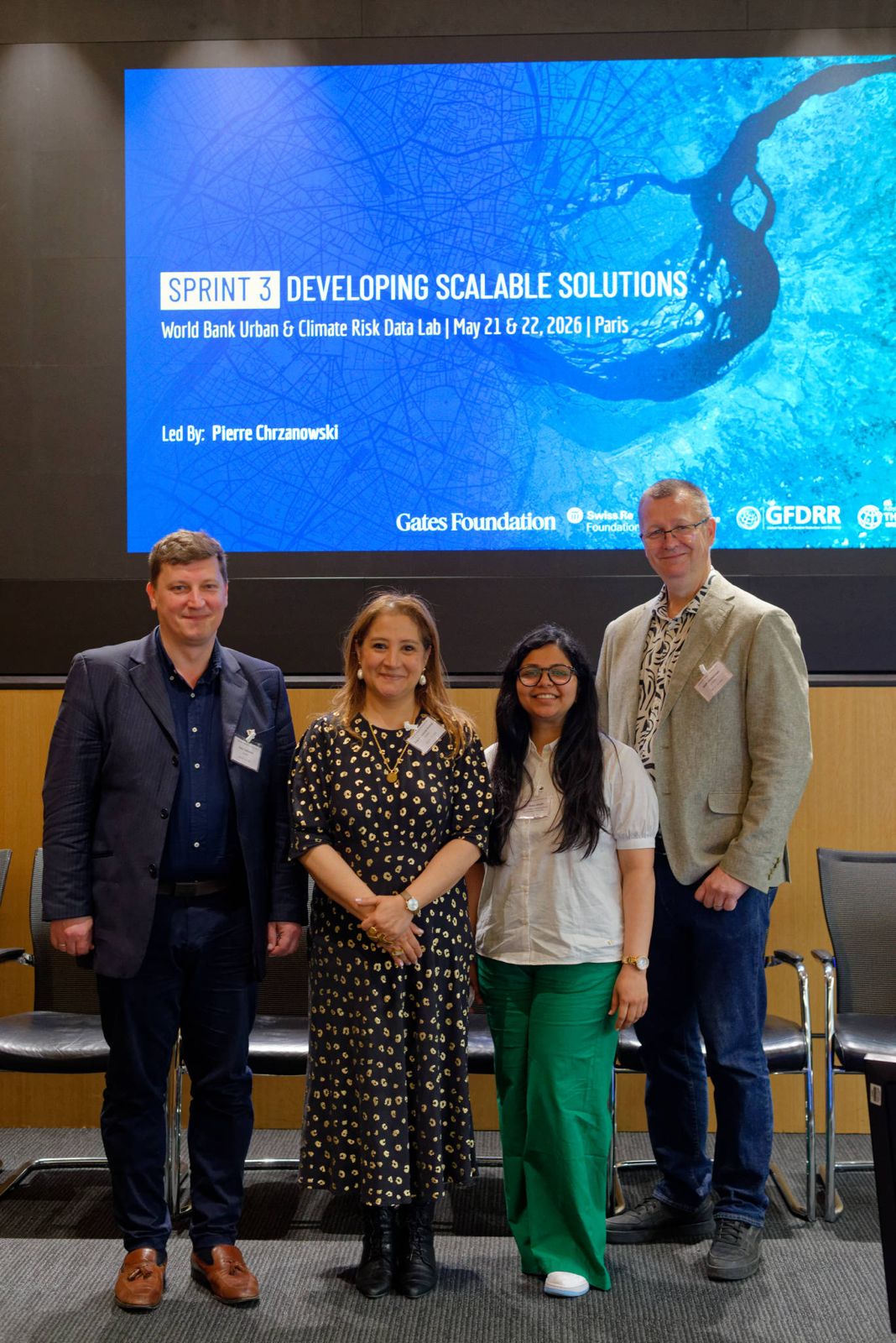
CODATA team at the Urban Risk and Climate Risk Data Lab workshop. From left to right, Slava Tykhonov, Burçak Başbuğ, Shaily Gandhi, and Matti Heikkurinen.
For many people, the first associations with the word “Urban” are perhaps related to progress; skyscrapers surrounded by pristine parks, new opportunities, human connections and delightful cultural exchanges. However, this vision bringing people together also drives unplanned urban sprawl, as well as challenges that infrastructures and services struggle to cope with. Escape into population centres may also not be voluntary. For example, refugee camps often turn into permanent, growing settlements.
Independent of the drivers, concentration of population into urban centres also concentrates risks. The details may vary, but the number of individuals and the value of assets exposed to hazard events grows, while risk reduction activities and disaster response planning may face additional constraints. Unfortunately, the economic and social dynamics provide incentives to set these risks aside. The same pattern can often be observed in the approach to climate change, pandemic preparedness or maintenance of critical infrastructure. The combination of rapid urbanisation and climate change is an example of a situation where the growing, cumulative hazards may also be more than the sum of their parts.
At the same time, we have unprecedented access to data, thanks to initiatives such as Hyogo and Sendai frameworks and other mechanisms to track the impact of hazard events. We also have IT infrastructure to process these datasets efficiently and put them into context of climate and weather data. However, we need to use these resources better: at the moment, data is often siloed, inaccessible or incompatible for efficient risk assessment and response.