 Reflections from the Beijing Science Dialogue and International Science Council Midterm Meeting, Beijing, China | 19–23 October 2026
By Ntsundeni Louis Mapatagane (CODATA)
Ntsundeni Louis Mapatagena is Co-chair of CODATA Connect, CODATA’s Early Career Network, Director of Planning and Institutional Intelligence at Walter Sisulu University (WSU), MSc Environmental Sciences, Ph.D Candidate on the readiness of higher education institutions for energy efficiency and emissions reduction.
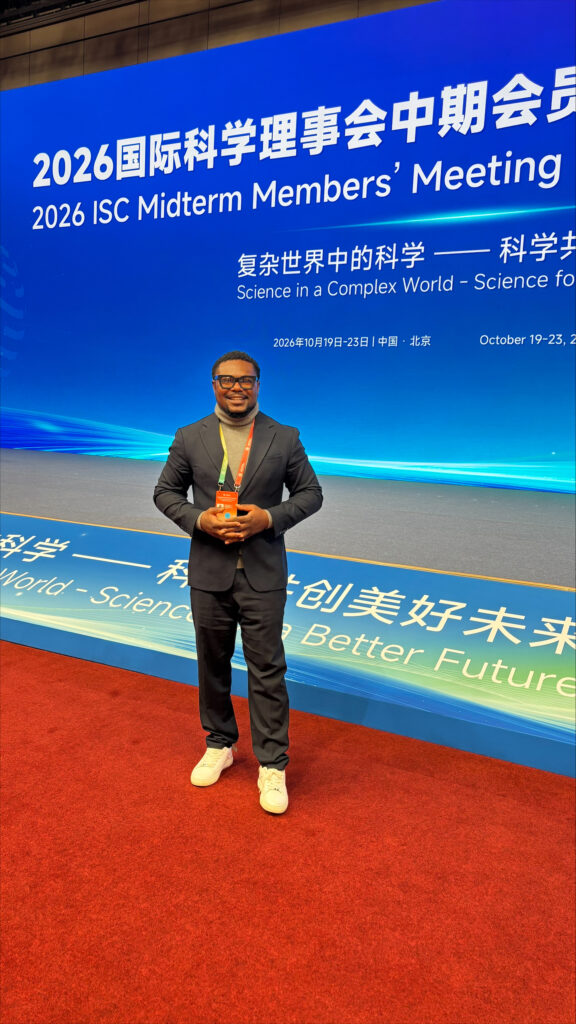 I travelled to Beijing, China, for the Beijing Science Dialogue and International Science Council (ISC) Midterm Meeting, expecting to engage in conversations about the future of science, international scientific cooperation and the opportunities and challenges presented by emerging technologies. I returned with something more profound: a renewed appreciation that the greatest challenge facing science may not necessarily be our ability to generate knowledge, but our collective ability to translate that knowledge into trust, responsible behaviour, effective policy and meaningful societal change.
Held under the theme Science in a Complex World – Science for a Better Future, the gathering brought together scientists, researchers, scientific organisations, policymakers and other stakeholders from across the world. What made the experience particularly meaningful for me was the convergence of several issues that have occupied my thinking for some time: artificial intelligence, science communication, research integrity, behavioural change, sustainable development and the responsibilities of universities in shaping our collective future. Three experiences stood out in particular: the Early- and Mid-Career Researchers workshop on AI readiness, the plenary discussion on science, society and trust, and the adoption of the Beijing Science Declaration. Although these engagements approached the future of science from different perspectives, they reinforced one central conviction: the future of science cannot be secured by technological progress alone. It requires stronger institutions, interdisciplinary collaboration, public trust and a shared commitment to ensuring that scientific advancement benefits humanity.
AI readiness: Are we preparing scientists for a future we do not yet fully understand?
My engagement began on 19 October with the pre-event workshop, AI Readiness and Accelerating Science Communication for Early- and Mid-Career Scientists, convened by the ISC with support from the China Association for Science and Technology (CAST).
The workshop explored how artificial intelligence is transforming science communication, research visibility and the ways scientists engage with society. However, what I found particularly interesting was not necessarily the discussion about AI tools themselves. It was the diversity and dynamism of the participants and panellists. The conversation brought together seasoned academics, open science policy researchers, and professionals working across the biological, health and other scientific disciplines. Each approached the subject from a different disciplinary perspective, yet the challenges raised converged in remarkable ways. We shared the practical realities confronting our respective fields, exchanged best practices, and considered possible solutions to challenges already emerging, as well as those we anticipate in the future. At times, the conversation felt almost like a futurist exercise. We discussed not only how AI is changing how we conduct and communicate research today, but also how these technologies could fundamentally reshape scientific work, research careers, and the relationship between science and society.
It became increasingly clear to me that no single discipline has all the answers.
Computer scientists may develop increasingly sophisticated AI systems, but deploying them raises questions that require the expertise of ethicists, psychologists, behavioural scientists, educators, environmental scientists, legal scholars, policymakers, and many others. The future of AI in science will therefore depend as much on our capacity for interdisciplinary collaboration as on technological innovation.
More importantly, the conversation raised a question that I believe deserves much greater attention: Are we merely preparing scientists to use artificial intelligence, or are we preparing them to exercise sound scientific judgement, ethical responsibility and intellectual leadership in an AI-enabled world?
The difference is significant.
AI can support researchers in synthesising literature, analysing data, modelling complex systems, visualising findings and communicating research to wider audiences. These opportunities are substantial, particularly for early- and mid-career researchers working within increasingly demanding research environments. Yet the same technologies can also contribute to misinformation, fabricated evidence, questionable authorship practices, biased analysis and the erosion of public confidence in scientific knowledge.
This is why I left the workshop increasingly convinced that science communication and science diplomacy must be recognised and professionalised as essential scientific capabilities, rather than treated as supplementary activities that researchers undertake after completing their primary research. Researchers should be equipped not only to produce knowledge, but also to communicate uncertainty, explain evidence responsibly, engage with different audiences and participate meaningfully in public discourse. In an age where AI-generated content can be produced and distributed almost instantaneously, the credibility of science will increasingly depend on our ability to distinguish verified knowledge from convincing but unreliable information. Scientific expertise alone is no longer sufficient. We must also develop the capabilities required to communicate that expertise responsibly.
Science, society and trust: Where are the behavioural scientists?
These reflections became even more pronounced during the plenary discussion on Science, Society and Trust, held on 21 October.
Chaired by Professor Márcia Barbosa, ISC Vice-President for Freedom and Responsibility in Science, the session brought together an impressive range of perspectives, including those of Professor Naomi Oreskes, Roberta D’Alessandro, Javier García-Martínez, Gong Ke, Maretta Kula-Semos, Mu Rongping and Yuan Xing.
The panel’s diversity reflected the complexity of the challenge itself. Science is becoming increasingly sophisticated and deeply embedded in our daily lives. Yet, paradoxically, it can also feel increasingly distant from the very societies it is intended to serve. We have unprecedented access to scientific knowledge and technological capabilities. At the same time, misinformation, distrust in institutions, political polarisation and growing inequalities continue to undermine the relationship between science and society.
The discussion reinforced the importance of openness, scientific freedom, responsible advocacy and meaningful public engagement. However, one question raised around the discussion resonated strongly with me: Where are the behavioural scientists and psychologists in these conversations?
I share this sentiment deeply.
As someone whose academic background includes environmental sciences and research on behavioural interventions, I have long been interested in the relationship between knowledge, attitudes, social expectations and human behaviour. During my master’s research, I investigated how different forms of energy-consumption feedback could influence energy-conserving behaviour in university environments. One of the most important lessons from that research was that providing people with information does not automatically change their behaviour. Behaviour is influenced by attitudes, social norms, perceived behavioural control, collective expectations and the environments within which decisions are made. In my research, subjective norms — the perceived social expectations that influence behaviour — emerged as a particularly important factor. This insight has continued to shape how I think about sustainability, institutional performance and the relationship between evidence and action.
Earlier this year, following the Global Sustainable Development Congress in Jakarta, I wrote an article titled Beyond 2030: Why Science, Trust and Behavioural Change Must Rebuild the SDG Agenda. In that reflection, I argued that the Sustainable Development Goals provided the world with a common framework for measuring progress, but measurement alone does not guarantee transformation.
The same concern informed my earlier reflection, Why the 2025 SDG Report Feels Personal — and What We’re Still Getting Wrong. The Beijing conversation brought me back to these arguments. We know a great deal about climate change, biodiversity loss, inequality, food insecurity and unsustainable consumption. We have decades of research, increasingly sophisticated models, comprehensive global datasets and internationally agreed development frameworks. Yet the world remains significantly off track in achieving the SDGs by 2030. This raises a fundamental question. If we already possess substantial scientific knowledge about the challenges confronting humanity, why are we still struggling to translate that knowledge into collective action?
The answer lies not in scientific discovery alone. It requires us to understand how people make decisions, why institutions resist change, how trust is established or lost, how social expectations influence behaviour, and how political and economic systems either enable or obstruct evidence-informed action. This is where behavioural science, psychology, sociology and the broader social sciences become indispensable. If science is to influence society, then understanding society must be central to the scientific enterprise.
I would go further and argue that rebuilding public trust requires more than communicating scientific findings effectively. It requires scientists and institutions to engage communities as partners in knowledge production, acknowledge uncertainty, demonstrate accountability and recognise that different communities experience scientific and technological advancement in different ways. Trust cannot simply be demanded based on scientific authority. Trust must be earned through transparency, integrity, participation and demonstrated public value.
The Beijing Science Declaration: A commitment that speaks to the Global South
For me, the most significant outcome of the Beijing Science Dialogue was the adoption of the Beijing Science Declaration: Science in a Complex World, Science for a Better Future.
Read the full blog here