
 CODATA is pleased to announce that — to coincide with the launch of the CDIF4EOSC project — Version 1.1 of the Cross-Domain Interoperability Framework (CDIF) has just been released, and can be found at https://cdif.codata.org.
Version 1.1 represents a substantial enhancement of the CDIF recommendations, with increased support for FAIR functional requirements, and a new technical approach, featuring validation tools and improved documentation. While a significant step forward, resulting from two years of implementation and further development since the initial CDIF release in May 2024, version 1.1 is also forward-looking: the CDIF4EOSC project has just started, and will drive the next major round of CDIF developments. To support this, improvements to date have been consolidated in version 1.1 and will provide a baseline for further developments led by the CDIF4EOSC project.
After the initial work in the WorldFAIR project, resulting in the release of CDIF version 1.0, the WorldFAIR+ Initiative continued testing and development of the framework. CDIF has been used in several different projects, including the OSCARS-funded CDIF4XAS project on X-ray absorption spectroscopy, implementation in the Climate-Adapt4EOSC project, the International Science Council supported project on Disaster Relief and Preparedness in Malawi, an ADA astro-materials prototype, and several others. Feedback from these projects has been incorporated in version 1.1, as have requested minor changes to some of the standards recommended for use. Version 1.1 may not be a major version change, but it represents a significant improvement in the maturity of the recommendations.
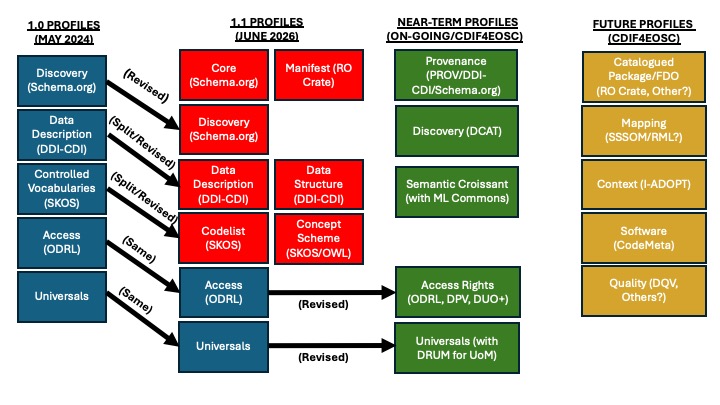
Changes in the scope and coverage of CDIF are:
- Identification of a set of Core fields, for use in all profiles
- Addition of support for binary data file such as HDF5, NetCDF, and Parquet
- Inclusion of the Manifest profile, to enable packaging of resources into FAIR Digital Objects (FDOs) using RO Crate or similar packaging technologies
- Reorganization of the Data Description profile to cover the publication of reusable data structure descriptions and variables with DDI-CDI
- Increased nuance in the description of controlled vocabularies with SKOS: Codelist and Concept Scheme profiles express the difference between lists of enumerated values used in data, and broader semantic resources
These features complement the existing capability to support FAIR access with ODRL and discovery and cataloguing using Schema.org. While significant work has been undertaken in the description of provenance information, this is not yet included in this release, nor is the upcoming revision to the Access profile. These profiles — along with several other enhancements for the description of Units of Measure, integration with Croissant for use by agentic AI, and a more-complete implementation using DCAT — are expected to be released soon. The CDIF4EOSC project will add additional support for describing data quality, context and complex variables (using (I-ADOPT), packaging (using RO-Crates), semantic mapping, and software resources.
Importantly in the CDIF 1.1 release, there is significant increase in the set of specific artefacts to support developers. CDIF Profiles now have a set of implementation tools and documentation, including:
- Detailed descriptions of each recommended metadata field
- SHACL rules for validation of JSON-LD instances
- JSON Schema for validation of JSON-LD instances
- JSON-LD Frames and Python tools for populating them
- A set of example instances
- Graphical documentation of the JSON Schema implementation
The production system for CDIF is now being transitioned to a UML Model-driven architecture, where a detailed model serves as the integrated source for all profiles, ensuring consistency across the entire set of implementation artefacts and alignment of metadata objects across different profiles and standards. All the various validation tools and documentation will be generated from this model. It is expected that the set of implementation tools will also be increased as CDIF continues to grow, with a major development effort being included in the CDIF4EOSC project.
CDIF version 1.1 establishes a strong basis for the implementation of systems to enable FAIR exchange across domain and infrastructure boundaries and paves the way for even greater future developments.