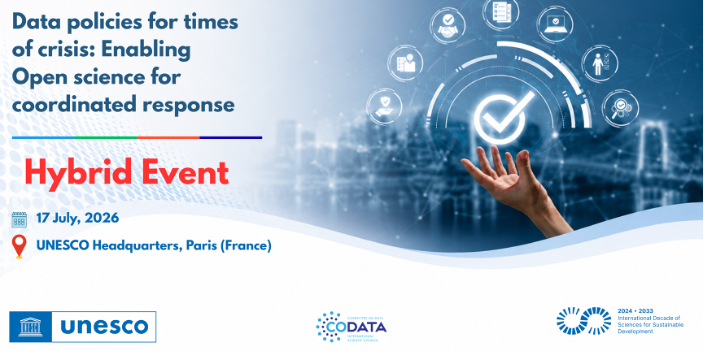
 The UNESCO-CODATA WG on Data Policy for Times of Crisis invites participation in a session as part of the 2026 Global Conference of the International Decade of Sciences for Sustainable Development (IDSSD), 15-17 July 2026.
The session on Data policies for times of crisis: Enabling open science for coordinated response will take place in Room XI and online, on Friday 17 July at 12:30-13:45 UTC / 14:30-15:45 CEST (Local Time Paris)
Register to attend the Data Policities for Times of Crisis (DPTC) online!
Register to attend in person and to attend the Global Conference https://indico.un.
Data policies for times of crisis: Enabling open science for coordinated response
As crises become increasingly complex, interconnected, and transboundary, timely access to trustworthy data is essential for effective preparedness, response, and recovery. This event presents findings from the first global UNESCO-CODATA survey on the implementation of Data Policies for Times of Crisis (DPTC) facilitated by Open Science.
Drawing on experiences from organizations across sectors and regions, the session examines how open science principles are being applied to crisis data governance, identifies implementation challenges and good practices, and explores opportunities to strengthen responsible, interoperable, and coordinated data sharing in support of sustainable development and resilience.
Background and Objectives
The growing frequency and complexity of global crises, including public health emergencies, natural hazards, climate-related events, and humanitarian crises have highlighted the critical importance of timely, reliable, and interoperable data. Effective crisis response depends on the ability of institutions to share, access, and use data across sectors and borders while ensuring ethical safeguards, accountability, security, and respect for human rights.
To support these efforts, UNESCO, in collaboration with the International Science Council’s Committee on Data (CODATA), developed the Data Policies for Times of Crisis (DPTC) facilitated by Open Science resources, launched in 2025 as part of the UNESCO Open Science Toolkit. Grounded in the 2021 UNESCO Recommendation on Open Science and aligned with internationally recognized principles such as FAIR (Findable, Accessible, Interoperable, Reusable), CARE (Collective benefit, Authority to control, Responsibility, Ethics), and TRUST (Transparency, Responsibility, User focus, Sustainability, Technology), the DPTC Toolkit provides practical guidance to governments, research institutions, UN agencies, civil protection authorities, and other stakeholders seeking to strengthen crisis data governance.
The event is hosted as a thematic session of the 2026 Global Conference of the International Decade of Sciences for Sustainable Development. It will present findings from a global UNESCO-CODATA survey conducted between March and June 2026, assessing how organizations are implementing data policies for times of crisis and applying open science principles in operational contexts. By examining current practices, implementation gaps, and emerging needs, the session will contribute to ongoing efforts to strengthen science-informed crisis preparedness and resilience worldwide.
The session has three objectives:
- Present the findings of the first global UNESCO-CODATA survey on the implementation of data policies for times of crisis.
- Facilitate dialogue among policymakers, practitioners, researchers, and international organizations on challenges and opportunities in crisis data governance.
- Identify priorities for strengthening responsible, ethical, and coordinated data sharing through open science approaches in support of crisis preparedness, response, and recovery.
Agenda
Please consult the agenda linked here
Expected Outcomes
The event is expected to produce the following outcomes:
- Increased awareness of the role of open science in enabling responsible and effective data governance during times of crisis.
- Dissemination of findings from the first global UNESCO-CODATA survey, providing evidence on current practices, challenges, and opportunities related to crisis data governance.
- Enhanced dialogue among policymakers, researchers, international organizations, and practitioners on strengthening institutional preparedness through open science-enabled data policies.
- Identification of priority areas for future capacity-building, policy development, and pilot implementation activities related to the DPTC Toolkit.
- Strengthened collaboration among stakeholders working to advance ethical, interoperable, and coordinated data sharing for crisis preparedness, response, and recovery.