Category Archives: CODATA Connect

Sustaining Research Data Capacity: Reflections from a CODATA Journey (2017–2025)

Felix Emeka Anyiam (Initial Co-Lead CODATA Connect 2019-2024)

In this post, Felix Emeka Anyiam, who was Initial Co-Lead of CODATA Connect, our Early Career Researcher initiative, from 2019-2024, reflects on his experiences over eight years of participating in CODATA activities.  In particular, he emphasizes the benefits of sustained collaborations and connections: “long-term, networked training matters more than one-off workshops” and praises the CODATA Connect and CODATA Data Schools model which allowed students to return in more responsible, leadership roles.  Felix’s story shows the CODATA Connect provided an environment and collaborations that benefited Felix in this journey. But it also shows how Felix’s open and generous character, his enthusiasm to participate, brought rewards. Please enjoy this uplifting story!  Simon HODSON, Executive Director, CODATA.

Welcome to Trieste: how it started, 2017

In August 2017, at the International Centre for Theoretical Physics (ICTP) in Trieste, Italy, I encountered research data science not merely as a set of analytical tools, but as a global public good. I arrived as a public health researcher from Nigeria, trained in epidemiology and biostatistics, seeking stronger quantitative approaches to interrogate health systems data. I left with something more enduring: an entry point into a global ecosystem shaped by CODATA’s commitment to open science, equity, and long-term capacity building.

The CODATA-RDA Research Data Science Summer School in Trieste offered more than technical instruction. It introduced a way of thinking about data, FAIR by design, ethically governed, and shared across disciplines and borders. Participants from low- and middle-income countries (LMICs) were not positioned as beneficiaries, but as peers and future contributors. CODATA functioned not as a sponsor, but as a convenor of people, ideas, and responsibility. That distinction would shape my professional trajectory in the years that followed.

Continuity as capacity: returning, deepening, expanding (2017–2018)

One year later, in August 2018, I returned to ICTP for the Climate Data Science Advanced Workshop, again under the CODATA-ICTP collaboration, with Clement Onime and Simon Hodson among the local organisers. This second invitation proved pivotal. It reinforced the idea that capacity building is most effective when it is iterative and cumulative, allowing participants to deepen expertise, cross disciplinary boundaries, and apply learning to new problem domains.


The 2018 programme expanded my analytical perspective beyond health to climate systems, environmental data, and computational modelling. Skills that later proved essential for interdisciplinary work at the intersection of climate, urban systems, and public health. More importantly, it signalled something fundamental about the CODATA model: participation was not episodic. There was an intentional pathway for return, growth, and contribution.

From Participant to Contributor: Teaching, Networks, and Leadership (2018–2025)

Following my initial training through the CODATA-RDA Research Data Science programmes in Trieste, the relationships established during those early years began to translate into sustained international collaboration. It was through these engagements that the foundations were laid for the first Urban Data Science Summer School in 2018, hosted by the Summer–Winter School at CEPT University, Ahmedabad, India, in collaboration with CEPT Faculty at the time, Dr Shaily Gandhi, marking an important expansion of CODATA-enabled capacity building beyond the initial training context. My role as a co-instructor extended this work to undergraduate and postgraduate cohorts.

Building on this momentum, the programme evolved into a more structured and geographically diverse initiative. The second edition of the Urban Data Science Summer School took place from 13 to 23 May 2019 (https://shailygandhi.github.io/UrbanDataScience2019/). These successive schools reflected not only the maturation of an academic programme, but also the strength of the collaborative networks that had emerged from CODATA’s training ecosystem, and networks sustained through shared curriculum development, co-teaching, and long-term professional exchange since those early connections in Trieste.

That same year, I was appointed inaugural co-lead of CODATA Connect, the organisation’s Early Career and Alumni Network, a role I held from 2019 to 2024 (https://codata.org/initiatives/data-skills/codata-connect/members/). CODATA Connect was established to address a persistent gap in global training initiatives: what happens after the workshop concludes. Rather than allowing capacity gains to dissipate, the network was designed as a continuity mechanism, enabling early-career researchers to remain engaged, visible, and supported within the wider CODATA ecosystem.

Working collaboratively with co-leads and core members from India, Costa Rica, Europe, Africa, Asia, Australia, and Latin America, CODATA Connect evolved into a distributed, peer-led platform for sustained skills development and exchange. Together, we coordinated a series of research skills webinars, thematic workshops, and podcast series that translated FAIR data principles, reproducibility, and ethical data stewardship into applied, domain-specific contexts. These activities included structured webinar series on research skills and reproducibility, smart and resilient cities, and open data practices, as well as hands-on technical workshops, such as training on distributed computing using Spark with R, explicitly targeted at early-career researchers in resource-constrained settings.

In parallel, CODATA Connect supported the development of cross-institutional podcast series, including Data for Resilient Cities, Data–Knowledge–Action for Urban Systems, Data for Disaster Risk Reduction, and Open GeoAI, which brought together researchers, practitioners, and policy actors to explore how open data, geospatial analytics, and AI can inform urban resilience, disaster risk reduction, health, and sustainable development. These initiatives not only expanded the reach of CODATA’s data-skills agenda but also created durable knowledge artefacts that continue to serve as learning resources beyond the immediate training context.

Throughout this period, my own contributions were embedded within this collective effort alongside colleagues such as Shaily R. Gandhi (Initial Lead-India), Mariana Cubero-Corella (Costa Rica), Anup Kumar Das (India), Neema Sumari (Tanzania), Kishore Sivakumar (Netherlands), Adenike Shonowo (Nigeria), Jacqueline Stephens (Australia), Jaime Rugeles (Colombia), Zhifang Tu (China), and others. We worked to ensure that CODATA Connect remained inclusive, interdisciplinary, and globally representative. The emphasis was consistently on peer mentorship, leadership development, and translation of open science principles into local research practice, particularly within low- and middle-income country contexts.

This trajectory reached a moment of continuity in August 2025, when I returned once again to ICTP, Trieste, this time not as a participant, but as a tutor and co-lead for the CODATA-RDA Advanced Workshop on Urban Data Science https://indico.ictp.it/event/10990).

Having first attended the CODATA-RDA programmes as a student in 2017 and 2018, returning as a facilitator underscored the iterative nature of CODATA’s capacity-building model. Alongside colleagues Dr Shaily Gandhi (ITU Linz, Austria) and Dr Neema Sumari (Sokoine University of Agriculture, Tanzania), I contributed to hands-on sessions on geospatial analytics for urban planning and policy, predictive modelling for population dynamics, infrastructure, and health-risk assessment, and decision-support systems for resilient and sustainable cities.

The 2025 workshop brought together researchers from multiple regions to deepen expertise in big-data analytics, computational infrastructure, urban and environmental data science, and ocean-science data, all grounded in FAIR principles and ethical data stewardship. Contributing to the same platform that had shaped my own formation in research data science reinforced a central lesson of this journey: effective capacity building is not a single intervention, but a networked process sustained through collaboration, continuity, and shared responsibility, where today’s participants become tomorrow’s instructors, mentors, and stewards of the global data ecosystem.

Broadening horizons: global exposure through CODATA-enabled opportunities

Alongside teaching and network leadership, CODATA-enabled pathways opened doors to broader global engagement. I was selected to participate in the International Training Workshop on Open Science and the SDGs hosted by the Chinese Academy of Sciences in Beijing in 2023, contributing to discussions on ethical data reuse and sustainable development. These collaborations produced the peer-reviewed article: Statements on Open Science for Sustainable Development Goals in the Data Science Journal, in which I was a co-author (https://doi.org/10.5334/dsj-2024-049). Earlier, I had been selected for Topics in Digital and Computational Demography at the Max Planck Institute for Demographic Research (Germany) and for the ALPSP Virtual Conference and Awards in the United Kingdom, one of only 20 global recipients.

Travel grants from CODATA supported participation in the ICTP Trieste programme (2018) and the Science for Development Workshop in South Africa (2020), underscoring CODATA’s practical commitment to inclusion. These experiences reinforced a consistent message: global capacity building is strongest when financial, intellectual, and institutional barriers are addressed together.

This period of sustained engagement and international collaboration was also marked by formal recognition from the wider scientific community. In 2025, I was inducted into Sigma Xi, The Scientific Research Honor Society, in recognition of my research contributions and commitment to advancing science in the public interest. While this honour is conferred independently, it reflects the cumulative impact of long-term investment in research training, open science practice, and global collaboration. The skills, networks, and values cultivated through CODATA’s capacity-building ecosystem were central to developing the kind of research profile and scholarly orientation that such recognition acknowledges.

SAIL 2025 as a milestone, not the destination

In 2025, I was invited to present at the Symposium on Artificial Intelligence for Learning Health Systems (SAIL 2025), co-hosted by Harvard Medical School and convened around a shared commitment to equity-driven, ethically grounded applications of artificial intelligence in healthcare. My presentation drew on doctoral research that applied machine-learning methods to examine inequities in HIV self-testing uptake across sub-Saharan Africa, using large-scale demographic health survey data from 24 countries (https://sail.health/event/sail-2025/program/).

The study employed Classification and Regression Tree (CART) and Random Forest models to identify socio-demographic predictors of willingness to self-test for HIV. Beyond methodological performance, the analysis foregrounded a persistent equity concern: rural populations, individuals with lower levels of education, and those in lower-income groups remain systematically underserved. The work demonstrated how predictive analytics, when designed transparently and interpreted responsibly, can inform targeted, community-embedded public health interventions rather than reinforce existing disparities.

What made participation in SAIL 2025 particularly significant, however, was not the event itself but the lineage that made meaningful engagement possible. The ability to work confidently across disciplinary boundaries, to interrogate data quality and representativeness, to foreground ethics and FAIR principles, and to communicate complex analytical approaches to diverse audiences was not acquired in isolation. These capacities were cultivated incrementally through long-term engagement with CODATA-led training programmes, teaching roles, and international peer networks.

Across plenary sessions, panels, and technical discussions at SAIL, a consistent message emerged: AI should not be framed as a luxury innovation for high-resource health systems, but as a practical, scalable tool for strengthening learning health systems where access, quality, and data infrastructure remain uneven. Conversations around AI-enabled clinical decision support in low- and middle-income countries, data governance for learning health systems, and patient-centred innovation resonated strongly with principles long emphasised within CODATA’s capacity-building ecosystem.

Several themes from the symposium were especially aligned with this trajectory. First, the centrality of context, that AI systems must be designed to work within real-world constraints rather than idealised data environments. Second, the discussions highlighted that data quality and equity cannot be treated separately: AI systems trained on incomplete, biased, or poorly governed datasets are likely to reinforce existing health disparities rather than mitigate them. Third, the importance of trust, transparency, and explainability, particularly when deploying models in sensitive or high-stakes health domains. Finally, there was a strong emphasis on collaboration over competition, underscoring the need for interdisciplinary and cross-sector partnerships to advance AI for health responsibly.

Seen through this lens, SAIL 2025 was not a destination, but a convergence point, where years of sustained capacity building translated into frontier research engagement. It affirmed that long-term investment in data skills, ethical reasoning, and global research networks enables researchers, particularly those working in LMIC contexts, to contribute meaningfully to shaping emerging conversations at the intersection of AI and health.

Rather than standing apart from earlier stages of training and collaboration, SAIL 2025 illustrated the cumulative effect of CODATA’s model: a pathway in which early exposure evolves into leadership, stewardship, and the application of advanced methods to questions of equity and public value.

From skills to stewardship: Governance and Responsibility

More recently, my engagement with CODATA has extended beyond training and programme delivery into data governance, interoperability, and infrastructure stewardship. I currently serve as a member of the Cross-Domain Interoperability Framework (CDIF) Working Group and Advisory Group, where I contribute to the development and review of interoperability standards, emerging CDIF profiles, and strategic oversight for globally connected data ecosystems. This work involves close collaboration with an international body of senior experts, as well as ongoing technical discussions focused on enabling responsible data reuse across domains.

In parallel, I serve as a reviewer for the Data Science Journal and have contributed to CODATA’s Smart Cities Task Group and the Resilient and Healthy Cities Working Group, with a particular focus on data-driven approaches to urban health, climate resilience, and risk reduction. These roles reflect an increasing emphasis on stewardship, helping to shape not only how data are analysed, but how they are governed, shared, and translated into public value within complex socio-technical systems.

This evolution from skills acquisition to systems-level responsibility has been further strengthened through formal engagement with public-sector digital governance. In December 2025, I completed the AI and Digital Transformation in Government programme delivered by Saïd Business School, University of Oxford, in collaboration with UNESCO. The programme offered a rigorous, practice-oriented exploration of how governments can responsibly harness artificial intelligence and data-driven technologies to deliver inclusive, ethical, and effective public services.

Key areas of focus included AI ethics and governance, human-centred service design, digital leadership, cyber resilience, and the management of systemic change within public institutions. Importantly, the programme foregrounded the role of evidence, accountability, and institutional capacity in ensuring that digital transformation serves citizens rather than exacerbates existing inequalities.

Taken together, these governance, editorial, and policy-oriented engagements reflect a central lesson of sustained capacity building: technical competence must ultimately be matched by institutional responsibility. The transition from learning how to use data to helping shape the frameworks that govern its use represents a critical step in ensuring that data science and AI contribute to equitable, trustworthy, and socially grounded outcomes at scale.

What this journey tells us about sustaining capacity

Several lessons emerge from this journey. First, long-term, networked training matters more than one-off workshops. Skills persist when they are reinforced through return, teaching, and community. Second, effective capacity building produces leaders and stewards, not just analysts. Third, continuity, supported by mentorship, alumni networks, and governance roles, is essential for translating training into durable impact, particularly in LMIC contexts.

Looking ahead

As data science and artificial intelligence increasingly shape global responses to health, climate, and development challenges, CODATA’s model offers a compelling blueprint. Capacity building is not an event; it is a commitment sustained over time. For early-career researchers, particularly those working in resource-constrained settings, CODATA continues to demonstrate what is possible when openness, equity, and continuity are placed at the centre of scientific practice.

Short Biography of the Author

Felix Emeka Anyiam is a public health researcher and data scientist based at the University of Port Harcourt, Nigeria. His work focuses on the ethical and equitable application of data science and artificial intelligence to health systems, urban resilience, and development challenges in low- and middle-income countries. An alumnus and long-term contributor to CODATA-led Research Data Science programmes, he has served as co-instructor in CODATA-RDA Advanced Workshops, inaugural co-lead of CODATA Connect (the Early Career and Alumni Network), and a member of multiple CODATA task and working groups. His research and teaching emphasise FAIR data principles, reproducibility, and responsible data governance within global and local research ecosystems.

Beyond Articles: Rethinking Diamond Open Access for a Data-Driven Research Future

What would it take for Diamond OA to evolve into a holistic, equitable, and data-rich scholarly ecosystem — one that meaningfully includes early-career researchers?

More specifically, what kinds of alignment are required between policy, funding, research assessment, and infrastructure for Diamond OA to become a genuinely equitable and data-rich ecosystem that early-career researchers can meaningfully participate in?

These questions framed the CODATA Connect–convened session, “Beyond Articles: Rethinking Diamond Open Access for a Data-Driven Research Future for Early Career Researchers,” at the 3rd Global Summit on Diamond Open Access. Moderated and chaired by CODATA Connect co-chair, Pragya Chaube, the session began with a shared recognition that while removing Article Processing Charges (APCs) is a necessary step, it is only one part of a much larger system. Without parallel shifts in how research is evaluated, funded, and supported through infrastructure, Diamond Open Access risks remain structurally marginal.

The first hour of the session unpacked these interdependencies by examining how publishing models are shaped by research assessment, infrastructure availability, and governance capacity.

Moumita Koley situated Diamond Open Access within the political economy of scholarly publishing, emphasizing that publishing behaviour is ultimately driven by research assessment systems. These systems continue to reward publication in high-impact, commercially indexed journals, shaping both what research is valued and where it is disseminated. In this context, Diamond OA journals struggle for legitimacy not because they lack quality, but because they are poorly integrated into prestige-based evaluation frameworks.

Mohamad Mostafa of DataCite extended this argument by focusing on infrastructure. Research outputs today extend well beyond journal articles to include datasets, software, code, preprints, and reports. Yet many of these outputs remain invisible due to gaps in repositories, metadata practices, and persistent identifier adoption, particularly in emerging research regions. Without sustained public investment in interoperable open research infrastructure, Diamond OA cannot fully support these outputs, reinforcing global asymmetries in visibility rather than reducing them.


From an early-career researcher perspective, Cyrus Walther highlighted how these structural gaps translate into lived experience. Diamond OA increases reliance on community governance through peer review, editorial work, data curation, and reproducibility checks. Much of this labour already falls disproportionately on early-career researchers and remains unrecognized within assessment systems, risking an expansion of invisible work.

Rahul Siddhartan reinforced the need for alignment by pointing to disciplines such as high-energy physics, where community-led and Green Open Access models have scaled successfully. However, these models function where evaluation norms recognize community infrastructure and shared governance as legitimate contributions.

Taken together, the panel underscored a central tension. Open access must extend beyond free access to articles and encompass the underlying evidence that supports research claims. Yet incentives remain misaligned, infrastructure unevenly distributed, and governance labour under-recognized. Without coordinated reform across these domains, Diamond Open Access risks becoming an ethical aspiration constrained by structural realities.

The second hour of the session shifted from diagnosis to co-creation through breakout discussions.

Participants first examined what a realistic and fair minimum standard for data sharing and reproducibility might look like in the context of disciplinary diversity and unequal infrastructure. There was broad agreement that a single global standard would be neither feasible nor equitable. Instead, standards must be discipline-sensitive and context-aware, grounded in lifecycle thinking and long-term preservation. Infrastructure alone was seen as insufficient without accompanying training and professional support, while multilingual metadata was identified as essential for equitable global discoverability.

A second discussion addressed whether removing APCs is enough to prevent new divides between early-career researchers in high-income and low- and middle-income contexts. Participants emphasised that financial reform alone does not eliminate inequity. Persistent disparities in infrastructure, governance capacity, and recognition systems require coordinated policy responses, including reallocating existing subscription and APC expenditures toward national and regional open infrastructure. Libraries and public institutions were identified as key coordinating actors, alongside the importance of global disciplinary solidarity.

The final breakout focused on skills. Diamond Open Access demands competencies beyond academic writing, particularly in science communication, data stewardship, and societal translation. Institutions must formalise training pathways, senior researchers must mentor early-career colleagues in governance and leadership, and networks such as CODATA Connect can play a catalytic role in capacity building.

Together, the discussions reinforced that Diamond Open Access is not simply a publishing reform, but a systems reform agenda in which early-career perspectives must be structurally embedded.

The recording of the session is available on:

https://www.youtube.com/live/_zjJKbqB6Mo?si=8UZr0-jHxtMmlEkr (4:43:30 to 6:30:58)

A CODATA Connect Webinar on “Urban Data Space as New Frontier: A Responsible Research and Innovation Perspective” by Robert Braun

On 21 September 2020, a webinar titled “Urban Data Space as New Frontier: A Responsible Research and Innovation Perspective” was organized by the CODATA Connect Alumni and Early Career Network. This was the sixth webinar in the series on Smart and Resilient Cities, while other webinars are planned in the coming months throughout 2020. Dr. Shaily Gandhi of the CODATA Connect introduced the speaker and theme of the webinar series. As introduced, the speaker Dr. Robert Braun is currently a Senior Researcher and the Deputy Head of the Techno-Science & Societal Transformation research group at Institute for Advanced Studies (IHS) in Vienna, and Associate Professor at Masaryk University in Brno. He studied philosophy of arts and history at the University of Budapest and completed a Ph.D. in philosophy. He taught at numerous universities in the EU and the US. His research projects involve the representation and engagement of stakeholders in corporate communities as well as the societal impacts of autonomous mobility. 

Robert began his talk by introducing DataSpace and its short history. DataSpace is one of the new frontiers of innovation in digital technology. In recent conceptualizations of industrial DataSpace technology, different scholars envisioned DataSpace as an open business ecosystem for securing exchange and easy linkage of data, as Fraunhofer (2018) observed. Smart City projects worldwide intend to manage big data in urban environments and face the challenges of organizational complexities. European cities and communities require a set of tools to achieve a sustainable transformation towards smarter cities and municipalities and a structured approach to leverage the emerging data-driven economy’s potential, as perceived by Cuno et al. (2019). Then Robert introduced the Urban DataSpace (UDS), which facilitates an ecosystem for data exchange and added value creation utilizing various data types within a smart city or municipality. UDS may, thus, be seen as a new type of urban infrastructure. He pointed out while the relational database management systems served to focus the data management community for decades, rapidly expanding demands of ‘data everywhere’ have led to a new field in data science to emerge. UDS is one such emerging field.

He describes the actor-network theory (ANT) vis-à-vis the responsible research and innovation (RRI). In the ANT framework, technology serves as a distributed agency in actor-actant networks, networks serve as performed material-semiotic spaces, and there are multiple realities. On the other hand, the RRI framework assesses the social desirability, anticipation, reflexivity, responsiveness, and inclusivity of technology and innovation. 

He described the semiotics of DataSpace, i.e., mapping the problems in an artificial intelligence (AI)-based, or a data-driven environment. DataSpace serves as a ‘sign relational complex’ to support data science pragmatics, such as ascertaining, assessing, and researching the processes and intentions of data collecting agents or data analytics elements. There are concerns related to AI learning issues, particularly debiasing, black-boxing, semiotic complexities, and the multistability and multidimensionality of data. He briefly narrated the characteristics of trustworthy DataSpace and responsible DataSpace, respectively, based on the trustworthy AI principles and the RRI principles.

He opined that COVID-19 poses dangers of onlinefication of everything and (big)data-driven research and innovation. He further opined that the EU promotes responsible research and innovation (RRI) in principle, but the implementation leaves much to be desired. Robert Braun concludes that there is a need to improve the alignment of research policy and societal values in urban DataSpace and data-driven society.

Mr. Felix Emeka Anyiam of the CODATA Connect moderated the Question and Answer session and was assigned to obtain questions from the online participants keyed into the webinar question handle. Some of the questions were related to data sovereignty, how data localization can help in responsible and ethical DataSpace, and how GDPR takes care of responsible DataSpace. The speaker briefly appraised the audience on recent EU and international frameworks on the subject.  

The session was concluded with a vote of thanks presented by Shaily. She also announced the forthcoming activities of the CODATA Connect for the CODATA alumni and early career data science professionals.

Prepared by:
Anup Kumar Das
(Jawaharlal Nehru University, India, anup_csp@jnu.ac.in)
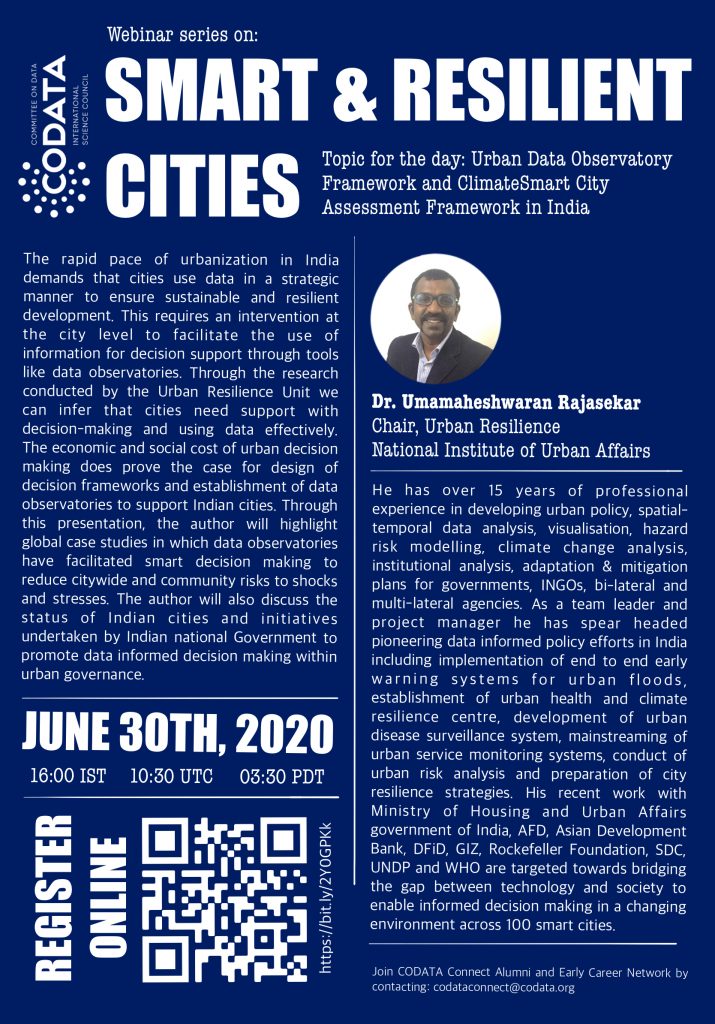
A CODATA Connect Webinar on “Urban Data Observatory Framework and ClimateSmart City Assessment Framework in India” by Umamaheshwaran Rajasekar

On 30 June 2020, a webinar titled “Urban Data Observatory Framework and ClimateSmart City Assessment Framework in India” was organized by the CODATA Connect Alumni and Early Career Network. This was the fifth webinar in the series on Smart and Resilient Cities, while other webinars are planned in the coming months throughout 2020. Dr. Shaily Gandhi of the CODATA Connect introduced the speaker and theme of the webinar series. As introduced, the speaker Dr. Umamaheshwaran Rajasekar is the Chair of Urban Resilience at the National Institute of Urban Affairs (NIUA) in New Delhi, India. As a team leader and project manager, he has spearheaded pioneering data-informed policy efforts in India including implementation of end to end early warning systems for urban floods, the establishment of urban health and climate resilience centre, development of urban disease surveillance system, mainstreaming of urban service monitoring systems, the conduct of urban risk analysis, and preparation of city resilience strategies. He has recently worked towards bridging the gap between technology and society to enable informed decision-making in a changing environment across 100 smart cities in India.

Umamaheshwaran began his talk by introducing India’s urban futures. He opined that half of India’s population is expected to be living in urban areas by 2050. Indian cities need to be better prepared to accommodate the expected growth as well as manage shocks and stresses. He further stated that many cities in India face challenges in providing essential civic services and managing their natural resources. He also opined that the poor planning for Indian cities would cost the economy between 1.2 and 6.3 percent of GDP. Many Indian cities are underprepared to manage shocks, such as the Chennai floods in 2015, and the Cyclone Hudhud in 2014 resulted in cumulative damages worth more than INR 240 billion, and loss of many human lives. Additionally, 116 AMRUT cities and 30 smart cities in India are prone to high risk of earthquakes. He then introduced the Datasmart Cities initiative in India of the Ministry of Housing and Urban Affairs (MoHUA) to help 100 smart cities promote data for better governance and innovation. In 2020, MoHUA established the Climate Center for Cities (C-CUBE) within NIUA with a vision to build climate actions in cities. This is a one-stop-shop for informed climate actions. He then introduced the Climatesmart Cities Assessment Framework 2.0, a first-of-its-kind city assessment framework on India’s climate-relevant parameters. The Framework is progressive and aspirational in nature and includes indicators in five broad categories, namely, Energy and Green Building; Urban Planning, Green Cover and Biodiversity; Mobility and Air Quality; Water Resource Management; and Waste Management.

He then discussed the concept of Data Observatory for Indian Cities. He defined an urban data observatory (UDO) as a platform that serves as a repository for accurate and frequently updated city-specific spatial and non-spatial data, and aids as a decision support system. The decision-makers will be able to use the data observatory to visualize trends, analyse data, and build scenarios to help stakeholders solve complex urban problems. The UDO adopts a multi-stakeholder and multi-sectoral approach, collating and visualizing data from various government and non-government agencies. He informed the audience that the NIUA is establishing a UDO in Chennai very soon in collaboration with Chennai Smart City Ltd, the Madras Chamber of Commerce and Industry, and IIT-Madras. He then presented a use case on water challenges in Indian cities. At the same time, a typical UDO for an Indian city serves the stakeholders such as the Municipal Commissioner, local businesses, and city dwellers. For each stakeholder, how a UDO contributes to a changed scenario is also discussed.

Mr. Felix Emeka Anyiam of the CODATA Connect moderated the Question and Answer session and was assigned to obtain questions from the online participants keyed into the webinar question handle. Some of the questions were related to the urban rejuvenation of Indian cities, their sustainability pathways, green cover, online availability of city-level data, data-driven decision making, and the climate-smart city assessment framework.

The session was concluded with a vote of thanks presented by Shaily. She also announced the forthcoming activities of the CODATA Connect, including an Essay Writing Competition on “Open Data Challenges to Address Global and Societal Issues”, the second webinar series “Research Skills Development”, and Smart and Sustainable Cities Datathon for the CODATA alumni and early career professionals.

Prepared by:
Anup Kumar Das
(Jawaharlal Nehru University, India, anup_csp@jnu.ac.in)

A CODATA Connect Webinar on “Trust Building for Effective Data Sharing as the Global Community Recovers from COVID-19” by Theresa Dirndorfer Anderson

On 25th May 2020, a webinar titled “Trust Building for Effective Data Sharing as the Global Community Recovers from COVID-19” was organized by the CODATA Connect Alumni and Early Career Network. This was the fourth webinar in the series on Smart and Resilient Cities, while other webinars are planned in the coming months throughout 2020. Dr. Shaily Gandhi of CODATA Connect introduced the speaker and theme of the webinar series. As introduced, the speaker Ms. Theresa Dirndorfer Anderson is a data and information ethicist passionate about shaping future digital and data infrastructures. Based in Sydney, Australia, she is an active contributor to local and international initiatives to humanize data science. Theresa’s award-winning work as an educator and as a researcher for the past twenty years engages with the ever-evolving relationship between people and emerging technologies through transdisciplinary and value-sensitive lenses. Her scholarly work involves the fundamental concepts of uncertainty, relevance and resilience. Before her academic career, Theresa worked as an analyst in research centres and think tanks. She has also worked as a diplomat and environmental education officer.

Theresa began her talk introducing the matter of trust in everyday life. Based on the literature, she opined, “Trust implies a projection; it involves a judgment that mobilizes both rational and emotional components, direct and indirect experiences.” She further stated that “Trust today is granted on two distinct attributes: competence, delivering on promises, and ethical behaviour, doing the right thing and working to improve society.” In this context, she explained ‘Building Trust’ in four quadrants, namely, ‘Reassurance’ encompassing communication and professionalism, ‘Resilience’ involving persistence and creativity, ‘Relationships’ embracing building and maintaining connections, and ‘Reflection’ involving time to think and test. She opined that trust-building is a matter of personal, local, and political choices. Through an audience poll, she demonstrated that the key to creating a trustworthy organization involves the government and legal frameworks, leadership from within the organization, governance frameworks within the organization, societal pressure, and citizen activism in equal measure.  Then she presented evidence from the Edelman Trust Barometer 2020 survey that shows trust restores balance and enables partnership. Among those who trust, institutions are more closely aligned. She opined that there is a need to demonstrate trustworthiness for tiding over the uncertainties and vulnerabilities in extreme situations such as the post-COVID19 world order. Building trust is needed from inside that involves working within the community and for the community, while accepting risk, responsibility, and accountability help in mitigating risks. She then presented her model of locating, trust-building, and ethical data practice in a sociotechnical framework, where she emphasized the gradual progression toward establishing legitimacy, working towards acceptance, establishing credibility, gaining and maintaining trust, and codesign. She elaborates on the ways forward in building public-trust with wellbeing as our driver, encompassing 4Rs, namely, Reassurance, Resilience,  Relationships, and Reflection. She brought in the insight from indigenous data sovereignty and indigenous data governance that the Global Indigenous Data Alliance (GIDA) promotes with the #BeFAIRandCARE campaign. Here FAIR Data supplements CARE data principles that stand for the collective benefit, authority to control, responsibility, and ethics. In her closing remark, she emphasized that public-trust is not lightly given; it is earned over time and is an ongoing process of engagement with the community.

Mr. Felix Emeka Anyiam of the CODATA Connect moderated the Question and Answer session and was assigned to obtain questions from the online participants keyed into the webinar question handle.  Some of the questions were related to the live surveys Theresa was doing using Menti.com. A participant commented on the Trust Barometer 2020 survey concerning some governments’ competency in building trust. 

The session was concluded with a vote of thanks presented by Shaily. She also announced the forthcoming activities of the CODATA Connect, including an Essay Writing Competition on “Open Data Challenges to Address Global and Societal Issues”, launching our second webinar series “Research Skill Development”,  and Smart and Sustainable Cities Datathon for the CODATA alumni and early career professionals.

Prepared by:

Anup Kumar Das
(Jawaharlal Nehru University, India, anup_csp@jnu.ac.in)

A CODATA Connect Webinar on “Data Science Enlightening the Path for Resilient Cities to Fight COVID-19” delivered jointly by Mahesh Harhare and Jairo Espinosa

On 11th May 2020, a webinar titled “Data Science Enlightening the Path for Resilient Cities to Fight COVID-19: Case studies from Pune (India) and Medellín (Colombia)” was organized by the CODATA Connect Alumni and Early Career Network. This was the second webinar in the series on Smart and Resilient Cities, while other webinars are planned in the coming months throughout 2020. Dr. Shaily Gandhi of the CODATA Connect introduced the speakers and theme of the webinar series. This time, the webinar had two speakers, namely, Mr. Mahesh Harhare and Dr. Jairo Espinosa. As introduced by the Chair, the speaker, Mr. Harhare is the Chief Resilience Officer (CRO) of the Pune Municipal Corporation in India. He holds M.Tech. in Urban Planning and completed Executive Program in Management from IIM Calcutta. As CRO  for Pune city, he is a part of the Global Resilient Cities Network (GRCN), formerly 100 Resilient Cities (100RC) program of the Rockefeller Foundation. He is also a member of the Global Steering Committee of select 10 CROs (out of total 85 CROs worldwide), who would steer the Phase II of the GRCN program across the world.

In his presentation, Mr. Harhare shared his experience in coronavirus infection management at Pune city. Pune is among the top ten Indian cities in terms of the number of infected persons with COVID-19 or SARS-COV-2. The COVID-19 situation and subsequent countrywide lockdown resulted in a high impact effect on cities’ economies. He further demonstrated how the city administration responded to COVID-19 management with an evidence-based decision making utilizing data science applications. In this presentation, he shared city-level data on COVID-19 positive cases, containment zones, medical facilities for the patients, civic facilities for the migrant labourers, senior and differentially abled citizens, contact tracking for the high-risk and low-risk contacts, and finally the deadbody management strategies. Most of the presented data were drawn as on 24th April 2020.

As introduced by the Chair, the speaker Dr. Jairo J. Espinosa is a Full Professor at the National University of Colombia in Medellín. For many years he served as R&D Manager in IPCOS N.V. company in Belgium. He completed Ph.D. degree in electrical engineering from the Katholieke Universiteit Leuven in Belgium. His research interests include large scale control systems, intelligent control, nonlinear modeling, model-based predictive control, inferential sensors, and model reduction techniques.

In his presentation titled “Data Science Enlightening the Path for Resilient Cities to Fight COVID-19: A case study of Medellin”, Dr. Espinosa shared data-driven Medellin’s defence tactics monitoring and prediction models, including on the profile of cases of vulnerabilities, monitoring, estimation and prediction of cases, the case locations, social and economical models, and logistics of local hospitals and healthcare institutions. Sharing the transport network capacity and mobility data, the speaker also demonstrated how the Medellin city prepares to end the lockdown and reopen public transport systems and mobility. He concluded with a statement that without vaccine and antiviral medicine, test, data, and models are our best hope for the moment.

Mr. Felix Emeka Anyiam of the CODATA Connect moderated the Question and Answer session, selecting questions posed by online participants using the webinar question tool. Some of the questions were related to how the city-level administrators are prepared to deal with the social and economic interests of the citizens and industries. During the Q&A Session, Mr. Harhare briefly discussed the Pune smart city project and how it contributed to COVID-19 management in the city. Dr. Espinosa briefly narrated how the city-level administrators in Medellin are managing to protect their high-risk, vulnerable communities, amidst the socio-economic uncertainties.

The session was concluded with a vote of thanks presented by Shaily. She also announced the forthcoming activities of the , which include an  for the CODATA alumni and early career professionals.

Prepared by:
Anup Kumar Das
(Jawaharlal Nehru University, India, anup_csp@jnu.ac.in)

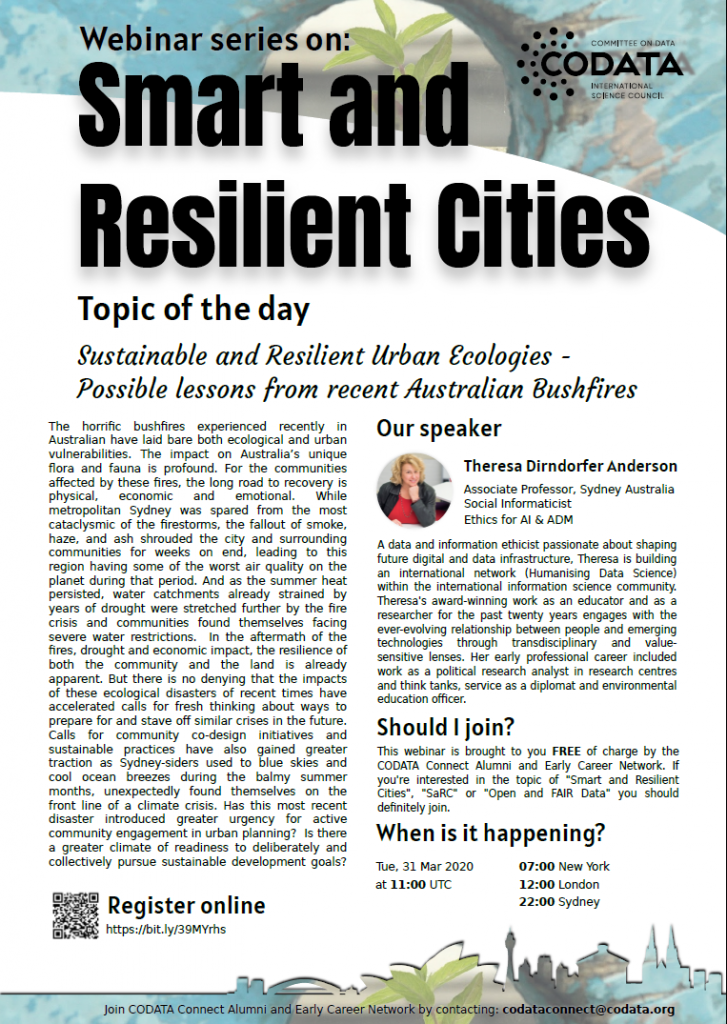
A CODATA Connect Webinar on “Sustainable and Resilient Urban Ecologies: Possible Lessons from Recent Australian Bushfires” by Theresa Dirndorfer Anderson

On 31st March 2020, a webinar titled “Sustainable and Resilient Urban Ecologies: Possible Lessons from Recent Australian Bushfires” was organized by the CODATA Connect Alumni and Early Career Network. Dr. Shaily Gandhi of the CODATA Connect introduced the speaker and theme of the webinar series. This was the first Webinar in the series on Smart and Resilient Cities, while other webinars are planned in the coming months throughout 2020. As introduced, the speaker Ms. Theresa Dirndorfer Anderson is a data and information ethicist passionate about shaping future digital and data infrastructures. Based in Sydney, Australia, she is an active contributor to local and international initiatives to humanize data science. Theresa’s award-winning work as an educator and as a researcher for the past twenty years engages with the ever-evolving relationship between people and emerging technologies through transdisciplinary and value-sensitive lenses. Her scholarly work involves the fundamental concepts of uncertainty, relevance and resilience. Before her academic career, Theresa worked as an analyst in research centres and think tanks. She has also worked as a diplomat and environmental education officer.

Theresa began her talk introducing the Sydney basin, its urban ecology and surrounding ecosystems. Located on the eastern coast, Sydney is the largest metropolitan city in Australia, accommodating about one-fifth of the country’s population. Australia is the sixth-largest country in the world but has third-lowest population density, just under three persons per square kilometer. Sydney’s urban boundary expanded rapidly in the last 100 years to accommodate the country’s growing population. The recent bushfires in the surrounding forests, national parks and peri-urban forests posed much higher risks and uncertainty to the city. Although the Sydney metropolitan area was spared from physical harm, the bushfires led to water stress, drought, a higher level of air pollution, warmer temperature, and other economical-ecological uncertainties to the local communities and city dwellers. Then the speaker talked about the city-level preparedness, resilience, community engagement, and compassionate behaviours of the local community in mitigating the sudden environmental hazards. There were significant instances of community members’ active involvement in the protection of distressed wildlife. Then the speaker presented the visions laid out in the City of Sydney’s Sustainable Sydney 2030 strategy and how the urban and regional communities re-evaluate the meaning of ‘sustainable’ and ‘resilient’ in the changing scenario. Theresa also described a new framework, named the Resilience, Adaptation Pathways and Transformation Approach (RAPTA), which is a guiding principle for designing, implementing, and assessing interventions for sustainable futures, as introduced by the Commonwealth Scientific and Industrial Research Organisation in Australia (CSIRO). The speaker presented a summary of lessons learned; namely, data is never complete, information never certain, but the action is still required; Indecision in light of the indeterminacy of information is a threat to the resilience of urban ecology; Building trust and mitigating risk critical to resilience; and Design WITH the city rather than FOR the city. She also discussed how data and information could play a significant role in tiding over the risks, vulnerability and uncertainties in extreme situations such as the Australian bushfires.

Mr. Felix Emeka Anyiam of the CODATA Connect Group moderated the Question and Answer session and was assigned to obtain questions from the online participants keyed into the webinar question handle.  Some of the questions were related to how the global community would be prepared to deal with such kind of huge risks, vulnerability, and uncertainties. The speaker emphasized community involvement while creating local and national preparedness plans. She mentioned that Data and information governance are also crucial to mitigate such conditions, and Data and information professionals should be handholding with the public policymakers, researchers, and development practitioners in creating sustainable urban futures across the world.

The session was concluded with a vote of thanks presented by Shaily. She also announced the forthcoming activities of the CODATA Connect, which include an Essay Writing Competition on “Open Data Challenges to Address Global and Societal Issues” for the CODATA alumni and early career professionals. 

Prepared by:
Anup Kumar Das & Iris Diana Uy
(Jawaharlal Nehru University, India, anup_csp@jnu.ac.in;
University of the Philippines – Diliman, Philippines, iris.diana.uy@gmail.com)