What would it take for Diamond OA to evolve into a holistic, equitable, and data-rich scholarly ecosystem — one that meaningfully includes early-career researchers?
More specifically, what kinds of alignment are required between policy, funding, research assessment, and infrastructure for Diamond OA to become a genuinely equitable and data-rich ecosystem that early-career researchers can meaningfully participate in?
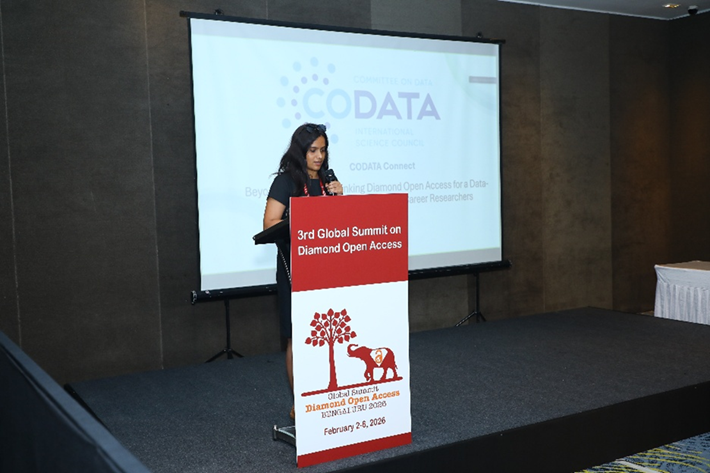
These questions framed the CODATA Connect–convened session, “Beyond Articles: Rethinking Diamond Open Access for a Data-Driven Research Future for Early Career Researchers,” at the 3rd Global Summit on Diamond Open Access. Moderated and chaired by CODATA Connect co-chair, Pragya Chaube, the session began with a shared recognition that while removing Article Processing Charges (APCs) is a necessary step, it is only one part of a much larger system. Without parallel shifts in how research is evaluated, funded, and supported through infrastructure, Diamond Open Access risks remain structurally marginal.
The first hour of the session unpacked these interdependencies by examining how publishing models are shaped by research assessment, infrastructure availability, and governance capacity.
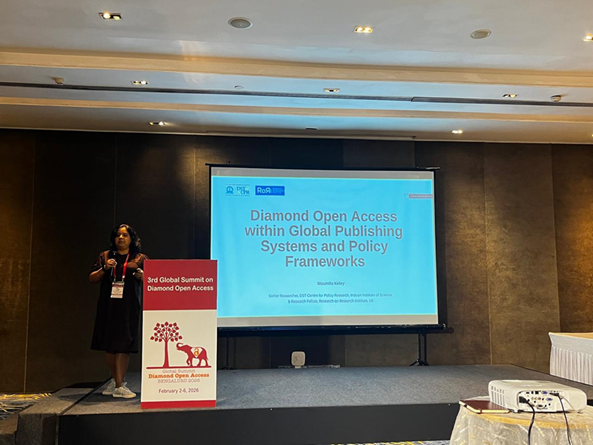
Moumita Koley situated Diamond Open Access within the political economy of scholarly publishing, emphasizing that publishing behaviour is ultimately driven by research assessment systems. These systems continue to reward publication in high-impact, commercially indexed journals, shaping both what research is valued and where it is disseminated. In this context, Diamond OA journals struggle for legitimacy not because they lack quality, but because they are poorly integrated into prestige-based evaluation frameworks.
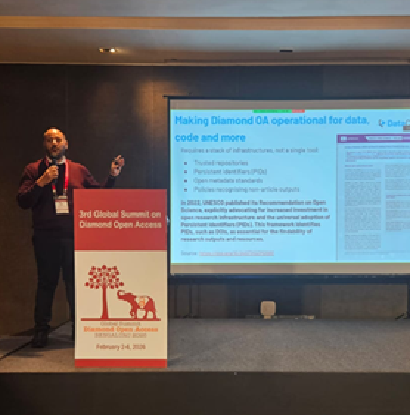 Mohamad Mostafa of DataCite extended this argument by focusing on infrastructure. Research outputs today extend well beyond journal articles to include datasets, software, code, preprints, and reports. Yet many of these outputs remain invisible due to gaps in repositories, metadata practices, and persistent identifier adoption, particularly in emerging research regions. Without sustained public investment in interoperable open research infrastructure, Diamond OA cannot fully support these outputs, reinforcing global asymmetries in visibility rather than reducing them.
From an early-career researcher perspective, Cyrus Walther highlighted how these structural gaps translate into lived experience. Diamond OA increases reliance on community governance through peer review, editorial work, data curation, and reproducibility checks. Much of this labour already falls disproportionately on early-career researchers and remains unrecognized within assessment systems, risking an expansion of invisible work.
Rahul Siddhartan reinforced the need for alignment by pointing to disciplines such as high-energy physics, where community-led and Green Open Access models have scaled successfully. However, these models function where evaluation norms recognize community infrastructure and shared governance as legitimate contributions.
Taken together, the panel underscored a central tension. Open access must extend beyond free access to articles and encompass the underlying evidence that supports research claims. Yet incentives remain misaligned, infrastructure unevenly distributed, and governance labour under-recognized. Without coordinated reform across these domains, Diamond Open Access risks becoming an ethical aspiration constrained by structural realities.
The second hour of the session shifted from diagnosis to co-creation through breakout discussions.
Participants first examined what a realistic and fair minimum standard for data sharing and reproducibility might look like in the context of disciplinary diversity and unequal infrastructure. There was broad agreement that a single global standard would be neither feasible nor equitable. Instead, standards must be discipline-sensitive and context-aware, grounded in lifecycle thinking and long-term preservation. Infrastructure alone was seen as insufficient without accompanying training and professional support, while multilingual metadata was identified as essential for equitable global discoverability.
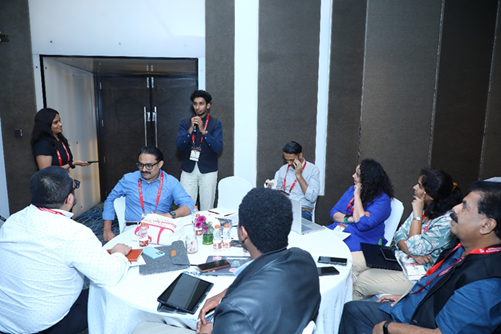
A second discussion addressed whether removing APCs is enough to prevent new divides between early-career researchers in high-income and low- and middle-income contexts. Participants emphasised that financial reform alone does not eliminate inequity. Persistent disparities in infrastructure, governance capacity, and recognition systems require coordinated policy responses, including reallocating existing subscription and APC expenditures toward national and regional open infrastructure. Libraries and public institutions were identified as key coordinating actors, alongside the importance of global disciplinary solidarity.
The final breakout focused on skills. Diamond Open Access demands competencies beyond academic writing, particularly in science communication, data stewardship, and societal translation. Institutions must formalise training pathways, senior researchers must mentor early-career colleagues in governance and leadership, and networks such as CODATA Connect can play a catalytic role in capacity building.
Together, the discussions reinforced that Diamond Open Access is not simply a publishing reform, but a systems reform agenda in which early-career perspectives must be structurally embedded.
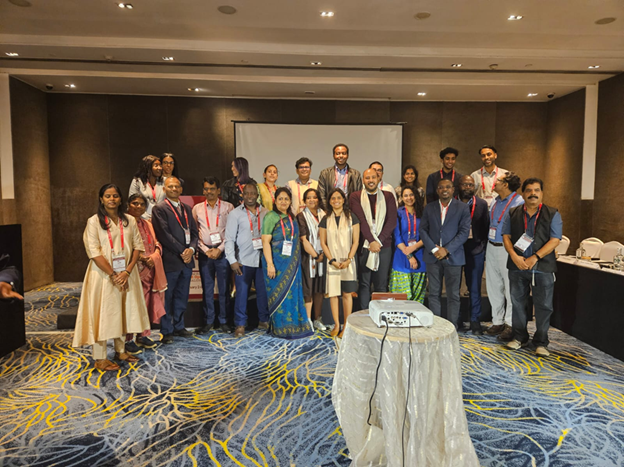
The recording of the session is available on:
https://www.youtube.com/live/_zjJKbqB6Mo?si=8UZr0-jHxtMmlEkr (4:43:30 to 6:30:58)