As I wrote this during the week of the solstice, the sun never set at the South Pole, and it never rose at the North Pole. That difference – the tilt of the Earth relative to the sun – drives the climate system. It gives us the seasons and the temperature differences that move the atmosphere and ocean.
The poles are also bellwethers of change. Glaciers, ice sheets, and sea ice are rapidly receding. Ground frozen for millenia is thawing and buckling. Coasts are flooding. People are displaced, and species are dying.
Understanding the poles is critical to understanding the Earth, but it is difficult to study a place that is often dark, cloudy, and frozen. Studying the poles requires coordination.
Initially, Western study of the poles was more about heroic exploration and conquest rather than scientific understanding. Then in 1875, one of those heroic explorers, Karl Weyprecht of the Austro-Hungarian Navy, realized that they needed to be better about collecting good data, and he proposed an internationally coordinated program of scientific observations. This ultimately led to the first International Polar Year (IPY) in 1882-83.
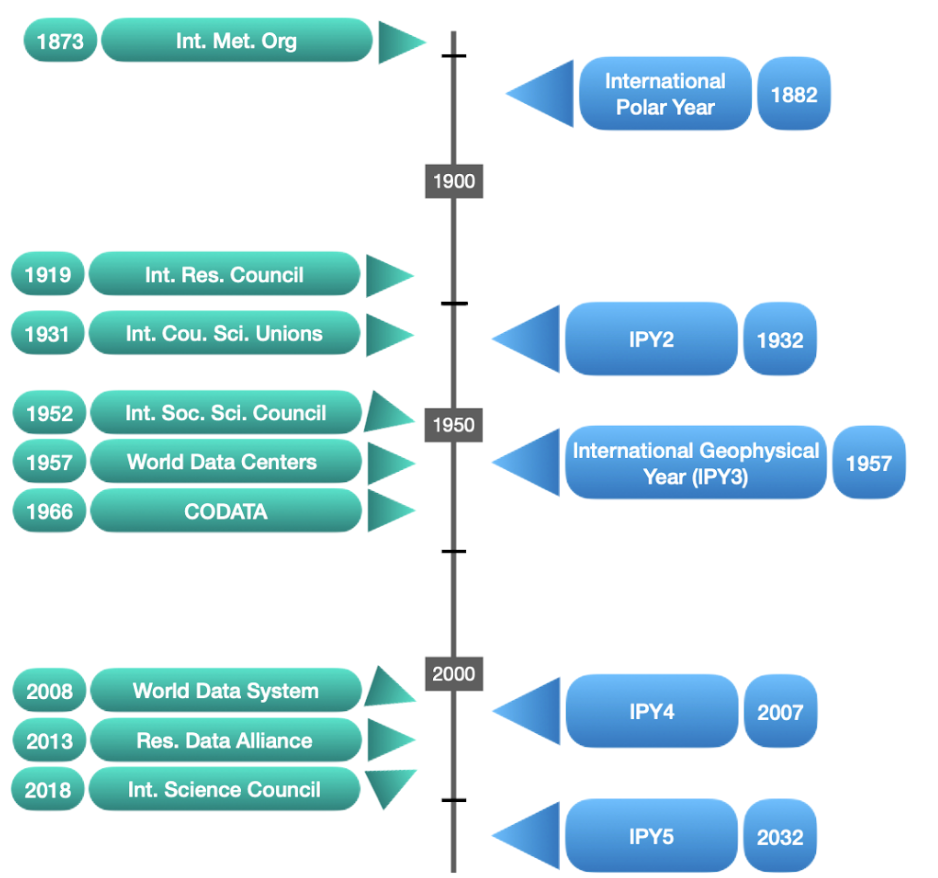
Since then, there have been three more International Polar Years in 1932, 1957, and 2007. Each of these marked a milestone in scientific coordination and data stewardship. IPY1 established meteorological stations that still collect ongoing records today. IPY2 established more stations and made major advances in radio science but also highlighted the vulnerability of data during major social upheaval (World War II). IPY3, the International Geophysical Year, launched the modern scientific era and established the World Data Centers to share scientific data across geopolitical divides. IPY4 made real the nascent concepts of ethically open data policy, federated data search, and respectful inclusion of Indigenous knowledge.
Indeed, as the timeline below illustrates, IPY has been intertwined with the roots of international scientific organizations and data systems.
Now we plan IPY5 (2032-33). What advances will it bring? CODATA has a keen interest in ensuring that IPY5 is a success and marks another step forward in data stewardship. We believe that with adequate resources, the data stewardship community should be able to support major international science initiatives almost as a matter of course. We know how to do this, and at the same time we can take advantage of modern technologies and what we have learned to accelerate Earth system science understanding even more.
The purpose of IPY5 is to unite scientists and Indigenous knowledge holders to advance polar research and produce actionable insights for mitigating and adapting to environmental changes, while promoting international collaboration and inclusivity. It is based on seven core principles (with items of direct relevance to the data community highlighted here):
-
- Fostering the widest possible international collaboration to produce knowledge for action with direct societal relevance.
- Committing to inclusive and diverse practices, including the implementation of equitable and ethical standards for engagement and cooperation with Indigenous Peoples and their knowledge systems.
- Striving for holistic, systemic, transdisciplinary research approaches that minimise environmental footprints. This includes co-design of research programs and co-production of knowledge across different knowledge systems, as well as ensuring that funding programs are directly supporting and financing Indigenous People´s comprehensive participation for the benefit of all parties.
- Ensuring balanced involvement and information flow, identification of areas of common interest, and effective knowledge exchange across Arctic and Antarctic polar research communities and networks.
- Encouraging open science and open data, according to the FAIR (Findable, Accessible, Interoperable, Reusable) and CARE (Collective benefit, Authority to control, Responsibility, and Ethics) data principles.
- Encouraging effective and inclusive science communication, polar education, and public engagement, both in the polar regions and globally.
- Engaging in capacity building and sharing for early-career scientists, Indigenous Peoples and those from historically under-represented groups across the polar regions and polar research disciplines.
The International Arctic Science Committee (IASC), the Scientific Committee on Antarctic Research (SCAR), the International Science Council (ISC), and the World Meteorological Organization (WMO) have established an IPY5 Planning Group, and CODATA was recently accepted as a member. I am acting as the CODATA representative and want to involve the broad data community. Let’s make sure data stewardship is embedded in IPY planning and action.
To that end, a group of us have proposed an IPY5 Data Task Group to develop an initial data strategy for data to be FAIR, handled with CARE, and preserved with TRUST. It will be an approximately 16-month effort to provide resources and develop recommendations, building on existing systems while identifying gaps. Chantelle Verhey (Arctic Data Committee), Jonathan Kool (WDS and Standing Committee on Antarctic Data Management), and Michaela Miller (Southern Ocean Observing System) co-chair the task group, and I am acting as a coordinator or secretary. The task group is open to all, so please contact me if you are interested. We want to make sure we connect to relevant systems and repositories beyond traditional polar organizations.
Although formal acceptance of the task group is still pending, CODATA supported my attendance at International Data Week and the subsequent Polar Data Forum. At IDW, we took a broad view. Michaela, Chantelle, and I led a working session entitled “So much going on!” How to best coordinate international efforts for data management. The idea was to identify ways where repositories can work “glocally” and serve the idiosyncratic needs of their immediate community while also fitting into global and interdisciplinary initiatives.
After some discussion we focussed on one key tension: Data providers do not adhere well to standards making integration into common systems difficult. We recognized that increasing automation and AI can help mitigate this, but contextual information from the provider is still essential. For example, repositories should be able to accept any common data format, but providers must still define the variables they used. The general takeaway was that researchers need to improve their data hygiene and data repositories need to relax their standards. This is not groundbreaking, but it illustrates the need for collaborative effort.
At the Polar Data Forum in Hobart the following week, we held an initial, half-day workshop to delve more deeply into IPY data planning. Participants divided into groups addressing different data planning topics. Each group identified relevant resources and initiatives and proposed recommendations to address the issues.
The four topics addressed were:
- The minimum set of ideas and considerations that should be front of mind when planning large international initiatives.
- An inventory of existing polar archives, data tools, protocols, vocabularies, and systems.
- Data advocacy and education for researchers and students.
- Funding for data planning, management, and coordination.
Each group produced detailed notes. The first group took a big picture view while the other three dug into more specifics. One online individual worked independently and clarified and reinforced several recommendations.
A central theme was that data management must be planned in advance and throughout a project. Data repositories must be identified and data systems defined before IPY begins, and this should be a requirement for IPY project approval. In that regard, an annotated inventory of data stewardship resources will be essential. We plan to develop a database or knowledge graph of these resources and welcome ideas and input. We would also like to see basic data training be a requirement of IPY participants. Ideally, a data professional would be embedded in every IPY project. At a minimum, data management funding must be included in every project and for the initiative as a whole.
Perhaps most critically, we as data professionals need to be looking forward. We need to be considering new and advanced methods using machine learning, cloud computing, and trusted research environments while remaining grounded in core principles such as FAIR, CARE, and TRUST. Equally important is the active and ethical inclusion of Indigenous knowledge. We only touched on this during the workshop. More dedicated effort is required.
CODATA sees IPY5 as an opportunity to demonstrate how solid data management is central to the success of any major scientific initiative. We aim to build on the history of past IPYs and ensure that the next IPY represents a step change in global data stewardship. Please join us: get in touch with Mark Parsons <parsonsm.work@icloud.com>.